Translate

Showing posts with label fixed-gear bike. Show all posts

03 March 2016

Biking in Joshua Tree National Park


The Joshua Tree
I've ridden the roads of Joshua Tree National Park twice so far. My first visit to the park was several years ago with Chuck and a couple friends from Vancouver to view the wildflowers in late March. We entered the park from the southeast at the Cottonwood Springs/Box Canyon exit of Interstate 10. Our route took us gradually up from the Sonoran Desert (1700 ft above sea level) to the Mojave Desert (at 3650 ft), along which you can perceive several micro-climates that encourage varying groups of cactus and agave. This drive can take about six hours, and it is only in the last half of the drive that you begin to see the piles of weather-rounded boulders that are popular with rock climbers.

During that drive, I had begun to think of the national park as a destination for a cycling excursion, although the route we took promised several hours of unrelenting climbing. My next trip to the park was with a friend who is an avid hiker. We drove 20 minutes from the northwest park entrance on relatively flatter roads to hike up Ryan Mountain. My appetite for cycling in the park was tantalized with this closer access and less challenging climbs.

Getting there

We drove 45 minutes north from Palm Springs and entered the park at its northwest gate.
North from Palm Springs
North and east on Highway 62
  1. North from Palm Springs on North Indian Canyon Drive.
  2. Indian Canyon Drive crosses Interstate 10 and continues along the west side of Desert Hot Springs. 
  3. North Indian Canyon Drive curves west and ends at an intersection with Highway 62 (also signed as 29 Palms Highway).
  4. Turn right onto Highway 62, on which you continue north and northeast through a pass to the community Morongo Valley.


  5. Stay on Highway 62 through the communities of Palm Wells, Little Morongo Heights, and up a long pass to the town of Joshua Tree.
  6. Turn right at Park Road, for which there is one brown national parks sign on the right. 
  7. You can buy a Senior Pass at the Visitor Center, which is on the right about a block after your turn.
  8. Continue on Park Boulevard as its name changes to Quail Springs Road.
  9. After about 4 miles, stop at the Gatehouse to pay entrance or show your Senior Pass.
  10. The first opportunity for parking and unloading bikes is a gravel turnout, about 1.5 miles from the Gatehouse, on the left side of the road.
 From Los Angeles or other desert cities, use the Highway 62 exit from Interstate 10 to replace steps 1 through 4.

8 March 2015

My first return to the park for cycling was with a group of visiting cyclists from New York's OutCycling (Wallace, Graham, Conrad, and Mike). We each rode at our own pace and distance, and I was plagued with three flats. So I was on my own, riding Deep Forest, my Serotta Colorado 48x15 fixie.

I had a flat in the first mile, and I returned to the car to use a floor pump. I flatted again at about 14 miles, and flatted again shortly after replacing the tube. It was then that I found a cactus needle that had been flexible enough to bend and be undetected with finger movement inside the tire. My frame pump left my tire a bit soft, and I flagged down Mike and others as they passed, who supplied a CO2 cartridge for full pressure.

26-mile out-and-back road ride beyond Ryan Mountain
Although the flats were a letdown, I still rode about 27 miles over fairly flat terrain that included 1200 ft climbing.
Playback of the ride

10 February 2016

More recently I rode with John Sickel, who is living here for the winter. He seems to be game for any new location for a ride, and he's as willing as I to try something new. I rode Blue, my Lotus Legend 48x16 fixie.

We toured most of the turn-offs for attractions in the park, including a long slog uphill to view Keys' Point. But after about 25 miles, John turned back while I explored further toward the 29 Palms gatehouse. I hoped to bike a metric century, and I calculated my turnaround to achieve close to that.

61-mile road ride out-and-back Y
The view from Keys' Point
The leg to Keys' Point was a slight incline for the first few miles, which became gradually steeper and steeper. The leg starts at mile 12.7 : 4251 ft, reaches mile 15.6 : 4466 ft at Lost Horse Mine Road, becomes aggressive at mile 17.1 : 4908 ft, and then finishes with two extreme 16.9% grades at the end, mile 18.6 : 5126 ft. Of course, the descent back made for a quick and exhilarating ride.

John Sickel at the portion of Pleasant Valley
We headed around Ryan Mountain and came to a sand plain filled with Joshua trees of huge size. John decided to turn back, as he neared 27 miles. I continued on, and a couple miles later I turned into the Jumbo Rocks campground, which was packed with RVs and tent campers for its mile length. On returning to the road (mile 30.6 : 4417 ft), I continued ever downhill along Park Boulevard, past the intersection with Pinto Basin Road (mile 35.6 : 3685 ft), and to turn around at a distance that I thought would make for a 100-km ride (mile 37.8 : 3250 ft).

My return was dogged at best, though I arrived at the car only a few minutes after John. But my calculations were off, so I asked John to follow me with the car and to pick me up after surpassing 61 miles of riding. (As it was, my conversion from miles to kilometers was off, and my ride still was 2 km short of a metric century.)
Playback of the ride

17 January 2013

Errands as commuting

Thursday, 17 January 2013

With a sunny day in January, overnight sales in our Amazon storefront, and receipt of a check from Nova Creative, today was perfect for taking the bike for my errands. And the bonus was the relative warmth today—fifteen degrees warmer than yesterday.

This is what commuting means for a work-from-home business. Take the opportunity to perform errands by bike. Where possible, group the errands so the ride can take you along the most efficient path that also provides something more than just a tour through the neighborhood.

Ride conditions
Temperature: 40 (end) to 44°F at 15:05 to 16:33
Precipitation: none
Winds: calm to 10 variable
Clothing: Skinsuit, longsleeve undershirt, ankle socks, tights, light jacket, full-finger gloves
Bike: Lotus Legend fixed 48x16 
Time: 01:28 for 15.61 miles
Heart rate: not available
Bikeway users: 1 cyclists, 8 pedestrians, 2 dogs
Playback of the ride

23 August 2012

Getting Ready to Commute Again

Wednesday, 22 August 2012

I've been off regular riding for more than ten weeks, due to Summer classes I've been taking at Wright State University. Then before that, I had no workday commute, since my work was at home, looking for a new employer. Now with two As on my transcript and after a couple companies have contacted me on my submitted resumé, it seems to be time to get back into commuting shape. Who knows where I'll be working, but it may be soon. (I hope.)

Today's ride was a leisurely 14.6 mph, starting with a book delivery to the Post Office and continuing on to the gym at Forrer and Smithville. (It used to be Cardinal Fitness, but a new owner has changed the name to Every Body Fitness.) The ride included a half-hour upper body workout of fairly low intensity.

I included a short leg out the drive from the Eastwood lagoons to the park entrance on Woodman, to check out the new construction of the connector to Huffman Park. The bikeway is staked out through Eastwood to its route underneath the bridge over the Mad River, and most of the path has received initial scraping. The equipment was actively scraping in mid-afternoon, and only a quarter mile remained unscraped in the park. I spoke to one of the men as he took a break in his pickup. They plan to complete the underlayment of gravel this year, and to apply asphalt in early 2013. The bikeway should be open by Summer 2013.

I told him that he should be proud of the work being done, since it provides a much needed link between Eastwood and Huffman parks. And an indirect, but important connection to Wright State University.

The construction of Highway 35 continues, and the Iron Horse Trail is broken into loose dirt just south of its juncture with the Creekside Trail. However, even during periods of actual work, the crews allow passage when it's safe to do so. The gates at either end of the bikeway through the construction area are movable—and light enough for almost anyone—to allow easy access.

Click here for information on other bikeway closures.

Charles Love

Charles experienced a solo crash this past Tuesday that left him with abrasions and a broken clavicle. But he's still smiling, and his bike is OK.

Ride conditions

Temperature: 84°F at 14:45
Precipitation: none
Winds: Variable 3.5 mph
Clothing: Skinsuit, ankle socks, open-finger gloves
Bike: Lotus Legend fixed 48x16
Time:  1:43:04  for  25.32 mi  miles
Heart rate: 131 bpm HRave, 157 bpm HRmax
Bikeway users: no count
Playback of the ride

09 September 2011

Bike-commute day 81—to work

Friday, 9 September 2011

Today, after two rest days for rain, was a sprint day. Kinda.

I felt strong through the Findlay Street bridge, and pushed into a sprint from the plateau to the gate to Eastwood Park. About 1:40 was at or above 150 bpm. Once my HR came down to the 130s, and after passing the double-L south of Park Lane, I took a short sprint almost to Airway, and then resumed the sprint after regaining speed from the crossing almost to Burkhardt—about 1:15 around 150 bpm. Then after crossing Linden, I took a third sprint for 1:00 around 150 bpm.

During all this, I met three regulars: Gary and Amy on their tandem and Paul and his dog Stinky.

Ride conditions
Temperature: 59 to 61°F at 07:45
Precipitation: none
Winds: calm to 5 mph variable
Clothing: Skinsuit, longsleeve undershirt, ankle socks, open-finger gloves
Bike: Lotus Legend fixed gear
Time: 00:41:27 for 11.94 miles
Heart rate: 136 bpm HRave, 158 bpm HRmax
Bikeway users: 6 cyclists, 7 pedestrians, 3 dogs
Playback of the ride

15 August 2011

Bike-commute day 67—to home

Monday, 15 August 2011

I left work very late—leaving my desk at 18:45, as the ever-earlier sunset rules me now. And as I rushed from the locker room in my cycling kit, Dave Stephens asked me as he approached the exit also, "What are those things on the bottom of your shoes?"

I lifted my heel as I held momentarily at the door. "It's a kind of cleat that mates to the pedals on my bike. Here, I'll show you at the bike rack."

I led him outside to my waiting bike, and then twirled the Shimano pedal. "The pedal is the same on both sides, for easy clipping in."

"Oh, so you can pull up as well as push down on the stroke!"

"Well, actually so I can apply power throughout the stroke, not only up and down, but also pulling back at the bottom of the stroke, and using the full circle of movement to apply power."

"Well that makes sense, to tie your leg to the machine."

"But that's not the only way to make the man-machine more efficient. You see the gears? It's just one gear on this bike, and it's a fixed gear—there's no coasting. When I pedal, the bike moves. And if I would happen to pedal backwards, that's the direction I would go."

By this time, I had turned on the Garmin, clipped it onto its pedestal, unlocked and recurled my padlock cable. I pulled the bike our of the rack and set it beside me, ready for the hop on.

"Well," Dave said, "I have to take the top down on my convertible. And you have the top down all the time, perfect for a day like this." He headed on to his waiting auto.

I gave Dave a whoop of a goodby and a wave. We were both looking forward to the commute home.

So with this fresh reminder of the importance of a circular, fluid stroke, I had additional power against the north winds that had open stretches to build their strength for the short ride along Spaulding Road before I turned into the Haverfield Canopy. I wondered if Dave's engineering background would incite thoughts of how the man-machine efficiency I experience compares to the power and joy of driving his vehicle.

Ride conditions
Temperature: 76 to 82°F at 18:15
Precipitation: none
Winds: 5 to 10 mph from the northwest
Clothing: Skinsuit, ankle socks, open-finger gloves
Bike: Lotus Legend fixed gear
Time: 00:41:09 for 11.95 miles
Heart rate: 135 bpm HRave, 152 bpm HRmax
Bikeway users: 30 cyclists, 17 pedestrians, 1 dog
Playback of the ride

14 April 2011

Bike-commute day 15—errand, weight training, and home

The first segment of this ride was by my trail bike, which I dropped off at Kettering Bike Shop for adjustment of its derailleurs and cables. I picked up my Lotus fixed-gear, which I used for the remainder of the ride.

Ride conditions
Temperature: 67 to 71°F at 19:45
Precipitation: none
Winds: calm to 5 mph
Clothing: 1 layer (skinsuit); ankle socks.; open-finger gloves.
Bike: Mongoose MGX D40 and Lotus fixed-gear
Time: 1:14:00 for 17.61 miles
Bikeway users: ~12 cyclists, ~25 pedestrians, 2 dogs

17:11—depart from work.
17:30—arrive at Kettering Bike Shop.
17:51—depart from Kettering Bike Shop.
18:01—arrive at Cardinal Fitness.
18:52—depart from Cardinal Fitness.
19:03—trestle remains at Linden.
19:15—west gate to Eastwood Park
19:23—passing the zig-zag up from the Mad River Bikeway.
19:37—arrive home.

05 April 2011

Bike-commute day 11—to work
How not to smooth auto-bike traffic

The rains stopped last evening, and the roads were dry in the morning. But as I crossed the Monument Street bridge, shielding my eyes from the bright sunshine, I saw the river was overflowing to the bikeway. Since I was on my Lotus fixed-gear, taking the gravel concourse above the river was out of the question, and I took the sidewalk—slowly, careful of two pedestrians and one with a vacuum cleaner in tow—against the flow of traffic in the street. At the ziz-zag down near the Green Bridge, I saw that the Mad River was living up to its name: an even higher and stronger flow was coursing into the Miami, and the bikeway was flooded at least to the railroad trestle near Valley Street.

So I took Monument Avenue through the light manufacturing area.

One pickup driver did everything possible to thwart his easy entrance to Monument from a service yard. As I rode along Monument going east, a pickup driver pulled to the street from a Rumpke service yard, stopped, looked both ways, apparently saw me, and released his brakes enough to coast an additional 3 feet. I interpreted his coasting as impatience and potentially a sign that he had not seen me approaching. I slowed a lot, expecting him to pull into the street. He stopped again. It was clear he had seen me, and he had just anticipated moving into the street prematurely. His impatience (my inference here) resulted in a few more seconds of stopping before his turn onto Monument, and (I infer again) increased what impatience he already felt.

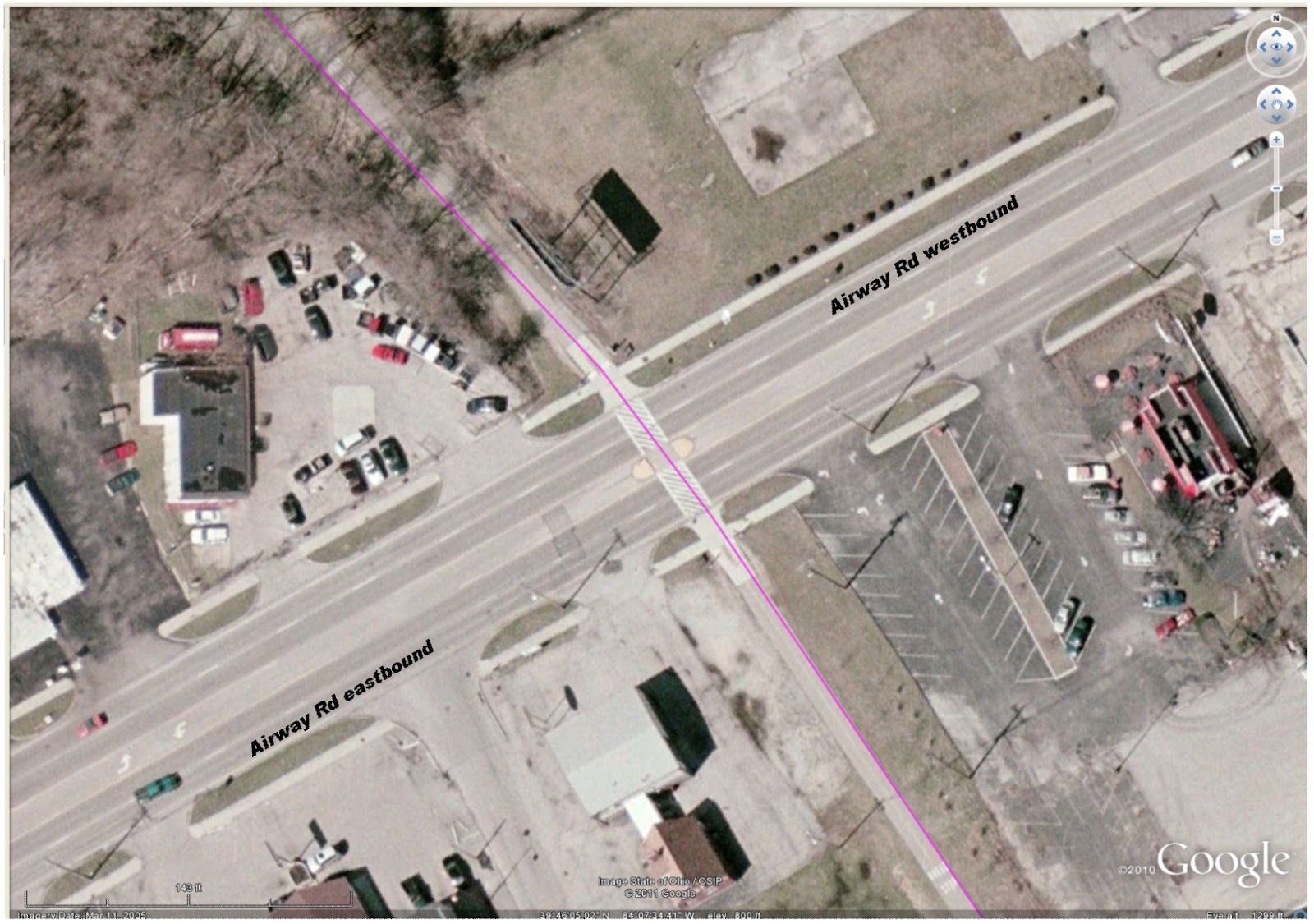
Bikeway crossing (magenta) at Airway Rd, Riverside OH
Then another pair of drivers exhibited their at-any-cost ownership of the road at the bikeway crossing at Airway. This crossing is well marked with pedestrian slashes embossed on the street, auto signs posted for the approaching two lanes of autos from each direction, in-path signage for the approaching bikeway users, and a pedestrian island placed to allow a pause in the crossing. As I approached the crossing from the north (top of image), the street was clear of traffic from the east, and two vehicles approached from as far away as Linh's Restaurant. —At about the location of the green car in the image.— I crossed the two westbound lanes, and saw neither of the two roadway users were slowing. So I stopped at the island. The near driver, of a pickup marked Extermital, sneered and flipped me off. Do I infer again some attitude of impatience—or dominance—from this driver?

No ego from me (for once) feels offence. No shift in mood. And my mood was heightened not more than a couple miles down the bikeway, at the corner of the DPL Executive Golf Course. My happy whistling startled three beautiful, strong deer who looked up from their grazing beside the bikeway. They glanced at each other, then scattered into the trees that line the bikeway. Four more deer inside the DPL compound galloped in the opposite direction toward the tree-lined creek.

At Woodbine, I saw Two-dog-Jason approaching the crossing from the south. Since I had to stop for a car, my crossing was slow. I introduced myself and Two-dog-Jason told me his name: Pat. It's been at least three years that we've seen each other on the bikeway during my morning commute. Finally there are real names for us to add to our hellos.

Central Park, New York City
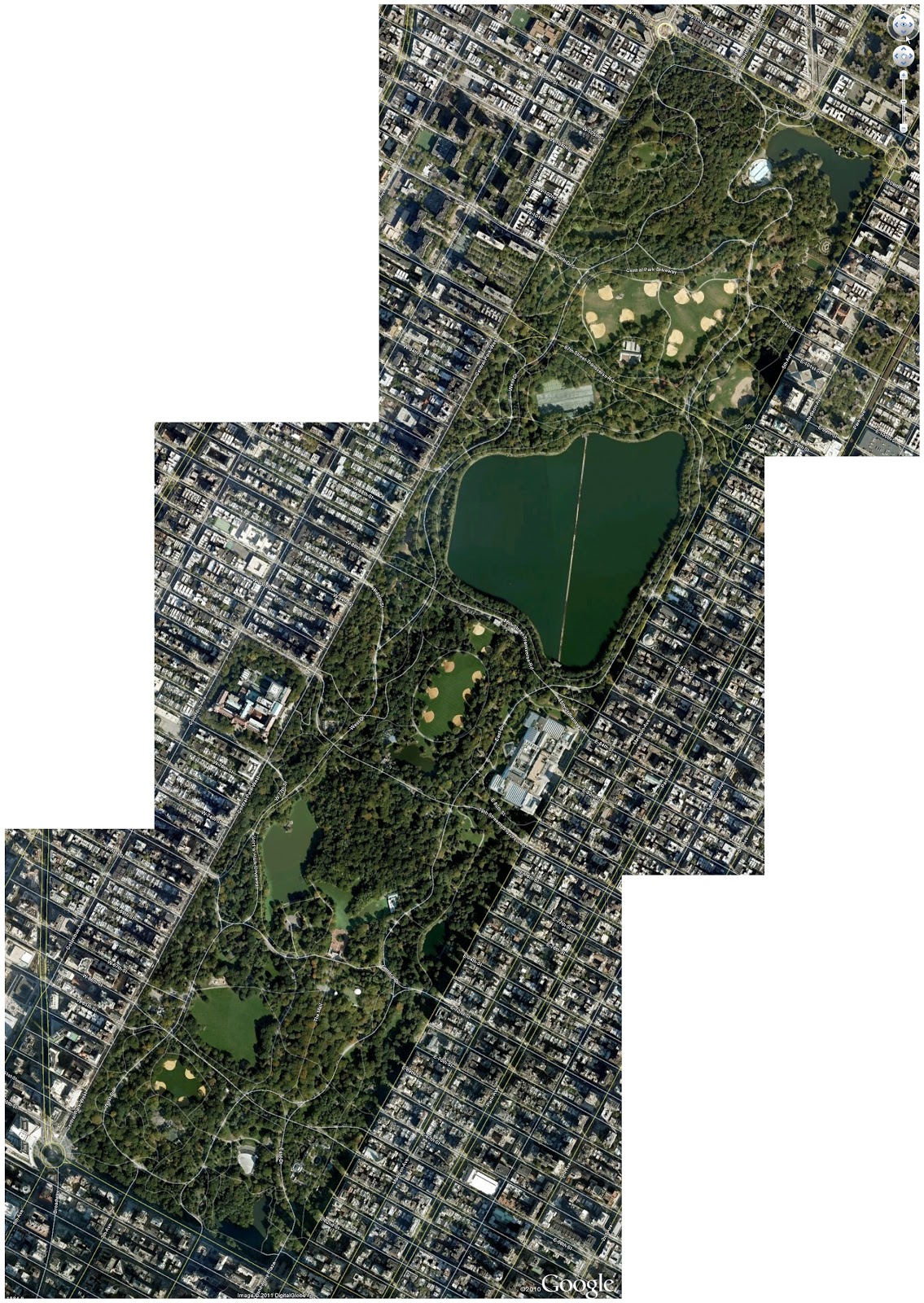
In New York City's Central Park another controversy is developing. In the hardcopy version, the article was titled "Neither Pedestrian Nor Auto." (It is otherwise titled in the online edition.) But the summarized assertion of the original title exhibits a basic misunderstanding of the position of the bicycle in the mix of transportation. Absolutely the bicycle is a vehicle. The cyclist is also a pedestrian—when a cyclist dismounts, the transformation is then complete. But nevertheless, all—motorist, cyclist, and pedestrian—must obey posted traffic signage. At issue for cyclists using Central Park are the questions of courtesy and obeying the hierarchy of trail usage. (In trail usage, cyclists must give right-of-way to pedestrians and horses; pedestrians must give right-of-way to horses; horses must give freedom-from-road-apples to everyone.)

From the few visits I have made to Central Park, it is not the best location for bicycle training. The number of strollers who also use the streets and paths that are closed off from vehicular traffic is too large for developing power, heart strength, stamina. The park is, though, well suited for the casual, pleasant Sunday ride with the family. Begging for attention is whether any convenient location exists on Manhattan Island for cyclists to train, free from the traffic snarls, exhaust, and stop-and-start progress of the streets.

Temperature: 37°F at 07:20, 29 to 39°F at 09:15
Precipitation: none
Winds: none
Clothing: Top with 4 layers (Lycra longsleeve undershirt, skinsuit, arm warmers, poly fleece vest, Lycra-wool jacket); Bottom with 2 layer (skinsuit, quilted tights); ankle socks. Quilted gloves. (Comfortable at first, but zipping down 3 of the top layers by the time I reached Woodbine. Moderate sweating in chest & back.)
Bike: Lotus fixed-gear
Time: 0:55:00 (approx.) for 11.86 miles
Bikeway users: 3 pedestrians, 4 dogs, 7 deer

07:50—departing from home.
08:xx—passing the zig-zag up from the Mad River Bikeway.
08:xx—passing the west gate to Eastwood Park.
08:xx—passing the trestle remains at Linden.
08:45—arriving at work. (No checkpoint times available.)

01 April 2011

Addition to Dayton Daily News article

In the middle of March, Robin McMacken of the Dayton Daily News asked me to answer several questions. The answers became the basis of an article that appears today in the Life section. There were other questions too, and here are my answers.

How long have you been riding?
I've been riding a bicycle ever since my mom & dad refused to drive me to school, when we moved to town for me to attend fourth grade—my first nine years were as a farmboy. So since I'm 59 now, this year is the golden anniversary of bicycling for me! Thanks for that revelation.

What have been the advantages and challenges to commuting via bike?
My use of a bike for commuting really started with my daily bicycling to elementary school, and when I had part-time jobs in junior high and senior high, I got there by bike and then biked to school. Then in college and in my jobs to support my college education, I used a bicycle to get around.

When I was without a car, I did everything by bike. I went to the grocery store more often, but I would have my large leather backpack filled as much as possible. The biggest challenge is the city itself, especially a city that is not cognizant of alternate modes of transportation. I lived in Houston a short time, on special duty in the Air Force and also for a short-term assignment to write for a Lockheed proposal for NASA. I tried cycling there for a week, but it was too dangerous because of the traffic.

The biggest challenge for centering your transportation around the bike is following the arts venues. I’ve always been interested in the arts and I like going to a concert, movie, or an art gallery or studio. But if I were to have only a bicycle to attend such events, it would be a challenge to balance such a sweaty mode of transportation with that part of my life. After all, that milieau expects attendance by a leisured person, or at least someone who doesn’t have the “aura of exertion” about him. So enjoying a broad cultural experience is almost anathema to the active life of a devotee of cycling.

What impresses you most about our area bike paths?
I love how interconnected our communities are by the bikeways. Of course, the connections aren't always direct, and some important paths are yet to be developed, but I can take bikeway to almost every part of the metro area—the greatest exceptions are Centerville, Oakwood, much of Kettering, and the mall shopping areas. The Five Rivers Metro Parks staff take great care of the paths and keep them clear of overgrowth, and the paths are safer than the roads and streets, both for cyclists and pedestrians.

I lived in Los Angeles for a couple years from about 1985 to 1987 and I used what they called bikeways, which were actually paved access roads to the concreted river system in the city. Believe me, the Dayton system, even then, was more extensive, a better transportation mode, and safer. I have never seen scores of homeless living near the bikeways here, nor neighborhood gangs. But in L.A., they were common.

What are you favorite trails in the area?
I enjoy the MOMBA trails. They are well cared for, compact, and they have a nice mixture of ease and challenge. Usually I bike there the same day that I help maintain the trails, which is the 3rd Saturday afternoon each month. I have a special place in my heart for the loop from Wegerzyn Gardens to the Green Bridge at Deeds Point. That's actually my partner Chuck's favorite area, and I have special memories because of times there with him. I really love all the trails, but I enjoy them mostly because there are enough to ride a lot and yet not repeat the same experience. —My commuting is the exception, though. Twice a day I take the same route, unless the river is flooded or a bridge is being reconstructed, and I always see some new detail, some change, some fresh indicator that Spring has come.

What kind of bike do you ride?
I have several bikes. I have a Serotta Colorado road bike that I bought for racing, with thin tires and a touchy shifter set, that I actually seldom ride now. I have an old, old Trek mountain bike, very basic, very durable, that I ride early in the year, before the streets and bikeways have been cleared of the Winter detritus. I have a bright yellow mountain bike with suspension, knobby tires, and heavy-duty gears and chain that I ride in MOMBA, near Huffman Reserve. I have a converted Lotus fixed-gear bike that has been with me a long time, at least since 1975, and I love it most. It has seen a lot of good times, and it's been with me in bad times too. I have what I call my "Beater Bike," that I have on vacations to ride off-road in rocky single-track.

Any safety tips you can give our readers to ensure their safety?
Always follow the laws for vehicles, and always ride defensively! Expect the worst from auto drivers, and you'll never be disappointed. Never leave home without a cell phone, some ID, preferably something like RoadID, which has medical emergency information and a website for detailed medical and contact data. And if you're a gay man or lesbian, carry the medical power of attorney you've worked out with your partner and lawyer. Accidents, real accidents, can happen anytime, anywhere. Be ready to help yourself and the emergency crews when you can't answer a simple question.


What health benefits have you enjoyed during your riding history?
Hmmm. My partner Chuck would ask what health hazards have I met head on: a car hit me in 1994 and nearly killed me—that's no exaggeration. In 2009, I slipped on a gravelly corner on the bikeway and found that I had osteopinea (a "mild" form of osteoporosis) because of the broken hip that occurred. And an inattentive driver hit me on a downtown street during a commute last September.

But I am an optimist, cock-eyed perhaps. My fitness and general level of health are greater than most people my age.

How many miles do you log weekly?
I commute from March to November, and I commute an average of four days a week. That's 100 miles almost exactly. Then I'll take a light ride with Chuck and maybe a longer solo ride too on the weekend. So perhaps my average is 150. That's pretty low compared to some cyclists I know, but I have a life off the bike too. Almost all of that milage is on the bikeways. My commute starts with 2 miles of quiet residential streets, then 10 miles of the bikeways before I have a quarter mile on Research Park streets.

Do you enter any races? If so, which ones are they?
I raced as a "kid" in my 40s. I wasn't any strong contender for a road racing title. Far from it; there wasn't a criterium that I wasn't pulled out of before being lapped by the advancing pack of younger riders. I started racing because I wanted to compete in cycling events in the 1990 Gay Games in Vancouver BC. I double-silver-medalled there, though the divisions by age were so narrow that I seldom had more than 5 competitors. Then after another four years of racing, when I was a week away from competing in the 1994 Gay Games in New York City, a car hit me in a training race held on open, rural roads under the auspices of the Dayton Cycling Club, but not authorized by any of the local sheriffs or other authorities. That put an end to cycling for me for several years, out of respect for all the concern and heartache that the surgeries and recuperation cost Chuck, and me too, of course.

Since that collision 17 years ago, I’ve become more cautious, and I ride when it's wet only if I’ve biked to work and rain comes before I can leave for home. I do ride on city streets occasionally, because the bikeways near the rivers may be flooded or bridge and road construction projects over the bikeways don’t typically provide an off-road bypass for cyclists. I try to choose those alternate streets as carefully as possible—Is there little or no traffic? Is there adequate lane width to separate cars from me? Is the distance short to another part of the bikeway?

My friends have asked why I continue cycling. I love the sense of freedom and independence, the multi-modal aspect of exercise and commuting, the beauty of enjoying and sensing every moment. And there are other, important things, like the low impact on the environment, the savings on car maintenance and fuel, and the certainty that this avocation is a healthy and fulfilling one.